/www.gundp.ch/file/3342/Rendre-la-chaleur-visible-Grolimund-et-Partner.png)
Heat is already here
The exceptional heatwave in June makes it clear what climate adaptation means in everyday life. Surface temperatures rise sharply in schoolyards, public squares and street spaces. Asphalt, concrete and dark surfaces store heat and release it well into the evening. Particularly in urban areas, the urban heat island effect intensifies the exposure, including at night.
When heat becomes a risk
What is merely uncomfortable for some can cause significant heat stress for older people, children, people with pre existing health conditions and occupational groups exposed to heat. Public spaces lose quality, schoolyards become barely usable and public squares empty at precisely the time when they should serve as places for people to meet.
Identifying problems precisely
To reduce heat effectively, it is first necessary to understand where it occurs. This is where thermographic analyses come in. Infrared cameras and thermographic imaging using drones make surface temperatures visible across an area. This allows heat hotspots to be identified precisely: heated surfaces, sun exposed façades, insufficient shading or areas with limited evaporation.
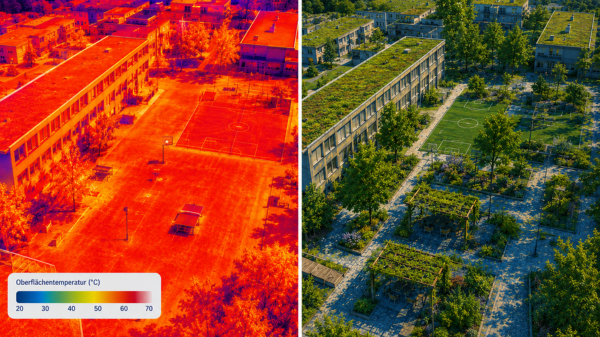
From measurement to impact
Simply identifying high temperatures is not enough. The key is to derive appropriate and effective measures from them. G+P supports municipalities, cities, and schools with scientific and measurement-based expertise: from a concise initial assessment to an in-depth detailed analysis.
Depending on the specific question, we combine:
• temperature measurements
• thermographic analyses
• site inspections
• microclimate assessments
• impact evaluations
Climate adaptation with a balanced approach
Climate adaptation measures need to fit the location, its use and the built context. Trees cannot be planted everywhere. Not every surface can be unsealed. This is precisely why site specific solutions are needed: shading, mobile greenery, light coloured surfaces, evaporative elements, water mist, seating areas or a combination of these measures. The aim is not the most spectacular measure, but the one that achieves the best effect under the given conditions.
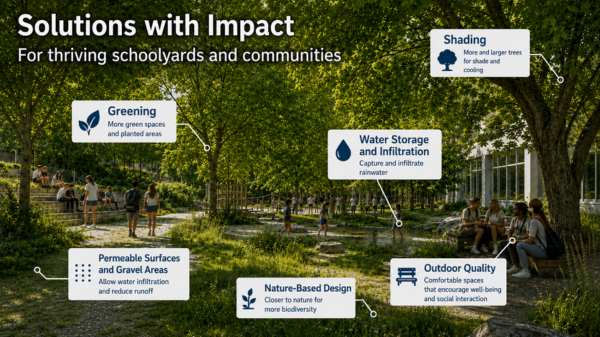
For public authorities and schools
Public authorities and schools are increasingly faced with the question of how public spaces can remain usable and safe during heat periods. School grounds, playgrounds, bus stops, squares and heavily used routes deserve particular attention. A sound analysis helps to set priorities, justify investments and communicate measures transparently to decision makers, the public and users.
Better decisions, backed by measurement
With its interdisciplinary expertise and extensive sensor technology, G+P supports the planning, implementation and assessment of climate adaptation measures. We identify where exposure is greatest, which measures are appropriate and how their effectiveness can be verified. This results in solutions that are not merely well intentioned, but technically sound and measurably effective.
More quality in public spaces
Heat mitigation is about more than reducing temperatures. It improves the quality and usability of public spaces and contributes to a more pleasant urban environment. Everyone benefits, especially those most affected by heat. Making heat visible therefore becomes the starting point for tangible improvements in everyday life.
Summary
The current heatwave clearly shows how important forward looking and impact oriented climate adaptation measures are. With thermographic analyses, G+P makes heat hotspots visible in cities, municipalities and schools and assesses heat stress using scientific analysis and measurement. This provides a robust basis for targeted planning, sound investment decisions and the long term improvement of public spaces.
Would you like to know where heat has the greatest impact on your school grounds, public square or street space? Contact us for an initial assessment. Together, we make heat visible and develop solutions that work.
/www.gundp.ch/file/2370/Titelbild_LAB_LCA_v4.png)
/www.gundp.ch/file/2849/Data_Science_E.png)
/www.gundp.ch/file/2914/blog_climate-change_heat-in-cities.png)