/www.gundp.ch/file/3196/Messungen-von-G%2BP.png)
/www.gundp.ch/file/3194/Urban%20Heat%20Island.png)
/www.gundp.ch/file/3195/Visualisierung%20einer%20Strasse.png)
Why This Matters Now
Hot days are becoming more frequent and more intense. At the same time, we are building roads and public spaces that are meant to last for decades. What is installed today will shape comfort, health and public acceptance far into the future. Planning with heat reduction in mind now can prevent costly retrofits later.
Asphalt as a Hidden Heat Source
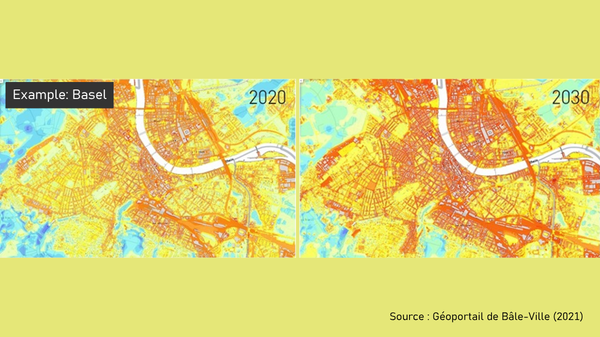
Asphalt surfaces make up a large share of public space. Under strong sunlight, they become significantly hotter than the surrounding air and release the stored heat again in the evening. This prolongs thermal stress and reduces the opportunity for people to recover during the night, when cooler temperatures would be desirable.
The Key Question
Cooler surfaces sound promising, but roads must do more than stay cool. They also need to remain skid resistant, deformation resistant, durable, acoustically compliant and economically viable. This is why solutions are needed that perform not only in the laboratory, but also in real urban environments.
What We Investigated
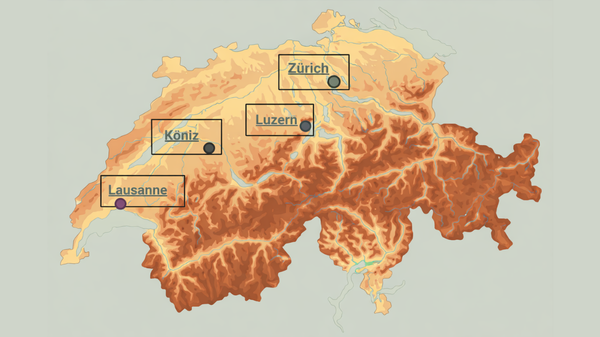
As part of the ASTRA project, light coloured aggregates from Switzerland were systematically identified and assessed. This was followed by laboratory testing of the mixtures and finally by field trials in four cities: Lausanne, Köniz, Zürich and Luzern. All tests were carried out using practical pavement types and standard construction procedures.
Field Testing Instead of Theory
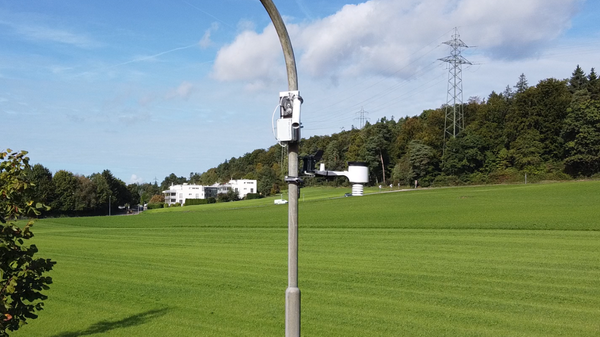
The test sections were monitored during summer under real urban exposure, including surface temperatures and indicators of radiant heat in pedestrian areas. In addition, skid resistance, surface condition and, at selected locations, noise performance were also assessed.
The Results in Degrees Celsius
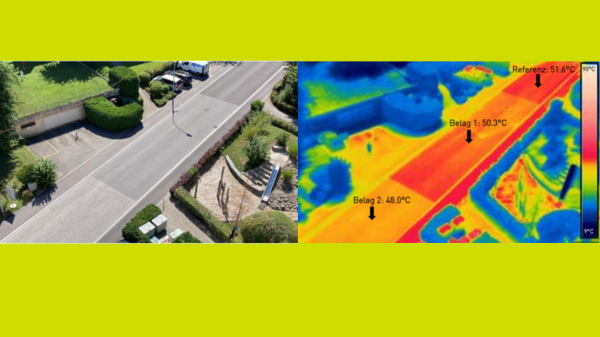
The ranking was consistent across all sites: reference pavements were the warmest, pavements using local Volken (Valais) aggregates were cooler, and Granusil (France), used as a reference material, was the coolest. For dense AC8 S asphalt, reductions with Volken were typically around 2 to 3 °C. For semi dense SDA pavements, reductions were typically around 3 to 4 °C. Granusil achieved reductions of up to around 5 to 7 °C.
Robust Performance Does Not Happen by Chance
The mixture design was crucial. Laboratory tests on deformation resistance, particularly cyclic compression testing, showed that new aggregates require iterative optimisation. However, once the formulation has been properly validated, standard Swiss paving practice also performs reliably in the field.
Benefits for Policy and Procurement Too
The life cycle assessment shows that bitumen and energy dominate emissions, but transport still remains relevant. Imported aggregates have a higher transport related environmental impact. Local solutions can therefore offer advantages here, while delivering comparable life cycle costs and a clearly measurable heat reduction effect.
Synthesis report: Cool Pavements V25.pdf (in German)
Conclusion
The project provides field validated evidence: cool asphalt surfaces are feasible in Swiss cities using local aggregates, while remaining functionally safe and suitable for practical application. The measurable temperature reductions are real, formulation testing is the key, and procurement decisions can be supported with LCA and LCC (life cycle assessment and life cycle cost analysis).
Are you planning a project this summer in a densely built up area? If so, now is the right time to assess whether cool asphalt surfaces can be meaningfully integrated, ideally in combination with other climate adaptation measures such as sponge city elements, improved public realm quality and biodiversity. Because what we design today lays the foundation for a resilient, healthy and liveable society tomorrow.
We would be pleased to support you with expert advice and planning, based on applied research and practical experience.
/www.gundp.ch/file/1350/Montage_Infrarotkameras_Bern_K%C3%BChle_Strassenbel%C3%A4ge.png)
/www.gundp.ch/file/2370/Titelbild_LAB_LCA_v4.png)
/www.gundp.ch/file/2849/Data_Science_E.png)