/www.gundp.ch/file/3255/3D-Texturmessung-Strassenoberflaeche.png)
/www.gundp.ch/file/3256/Bohrkern-Hohlraumanalyse.png)
/www.gundp.ch/file/3253/CPX-Messfahrzeug-mit-Anhaenger.png)
/www.gundp.ch/file/3254/Schichtaufbau-Strassenbelag.png)
Comparing two mixtures
Low noise road surfaces are among the most effective measures for reducing road traffic noise. However, it is often unclear which mixture will deliver the best long term performance. This is exactly where the Subingen project comes in.
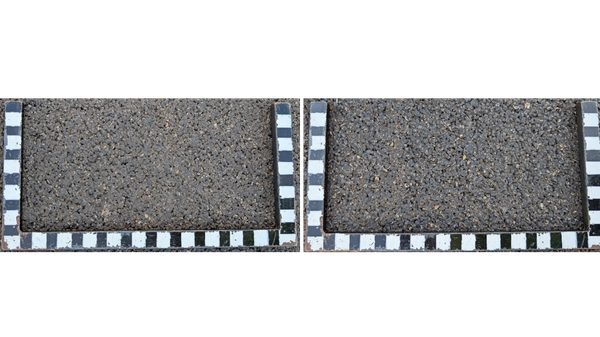
In 2025, the Office for Transport and Civil Engineering of the Canton of Solothurn installed two different SDA 4 semi dense asphalt mixtures with different void contents on Luzernstrasse: an SDA 4-12 and an SDA 4-16. The aim is to compare the acoustic performance of both variants over several years and provide a sound basis for future decisions.
Why standard measurements are not enough
A CPX measurement (Close Proximity Measurement) shows how loud or quiet a pavement is. However, it does not explain why pavements behave differently. Especially with similar mixtures, crucial differences often remain hidden.
To make these visible, G+P combines several measurement and analysis methods. This approach not only captures the acoustic properties, but also helps to understand the underlying mechanisms, from the surface right through to the pore system.
Five methods for clear answers
Five complementary methods are being used in Subingen. CPX measurements provide large scale acoustic assessment. 3D texture analysis captures the surface structure using millions of measurement points. Civil engineering investigations assess both the asphalt mixture and the installation quality.
The impact analysis breaks down the mechanisms responsible for sound generation. In addition, AVCA (Acoustic Void Content Analysis) makes the internal pore system visible. Only the combination of all these methods enables a complete understanding of the acoustic performance.
Initial results: Small differences, major impact
The first round of measurements already shows that both pavements achieve excellent initial acoustic values. The SDA 4-16 demonstrates an acoustic performance that is 1.5 dB(A) better than the SDA 4-12.
Detailed analyses also explain why: the SDA 4-16 has a more open pore structure. This reduces airflow resistance and increases sound absorption. Relationships such as these can only be identified reliably by combining several methods.
Evidence based decisions instead of assumptions
For cantons and municipalities, choosing the right pavement mixture is a decision with long term technical, financial and social implications.
G+P’s analyses provide the foundation for making these decisions with confidence. They help reduce risks, target investments effectively and optimise acoustic performance sustainably.
Added value for people and the environment
Less road traffic noise means a better quality of life. Residents benefit from reduced exposure, public spaces become more pleasant and legal noise limits can be met more effectively.
Projects such as the one in Subingen demonstrate how data driven analyses can make a tangible contribution to improving the environment, both today and in the future.
The project continues
Measurements will continue over the coming years. This will make it possible to observe how the acoustic properties of the two pavements evolve over time.
Ultimately, the project will create a robust database showing which mixture delivers the greatest long term benefit and how low noise pavements can be further developed in a targeted way.
Conclusion
The Subingen project demonstrates how in depth analyses go far beyond simple measurement values. Only the combination of different methods makes the crucial differences visible and enables reliable recommendations for practical applications.
Want to know more?
Would you like to gain a better understanding of the acoustic performance of your road surfaces?
Our Road Surface Acoustics team is here to support you every step of the way, from the initial measurements right through to in-depth analysis.
→ QuietPave, our product family for low noise roads
→ Pavement Acoustics specialist area
/www.gundp.ch/file/1625/CPX_Jaun_Quadratisch.jpg)
/www.gundp.ch/file/2370/Titelbild_LAB_LCA_v4.png)
/www.gundp.ch/file/2674/Blog%20und%20LinkedIn.png)