/www.gundp.ch/file/3145/effektives-monitoring-von-strassenlaerm.png)
Effective monitoring of road traffic noise: the importance of data homogenisation and automated processes
The challenge: insufficient, heterogeneous data and large data volumes
Noise modelling relies on a wide range of data, often sourced from numerous different systems. These sources and formats are usually heterogeneous and vary in quality. In some cases, the data is incomplete, inaccurate or even inconsistent, making reliable modelling difficult. In addition, the sheer volume of data means that manual processing can be extremely challenging. These issues require a structured approach and a solution that harmonises data and makes it permanently usable for calculations.
The solution: data homogenisation
This is where our solution comes into play. We use FME (Feature Manipulation Engine), a powerful tool for data homogenisation and integration. It enables us to standardise heterogeneous datasets from different sources and convert them into a format suitable for noise modelling. This ensures precise and reliable calculations based on harmonised data.
Thanks to this data preparation, we can then implement a semi-automated construction of the overall noise model, a significant advantage when working with large datasets.
Semi-automated construction of the overall noise model
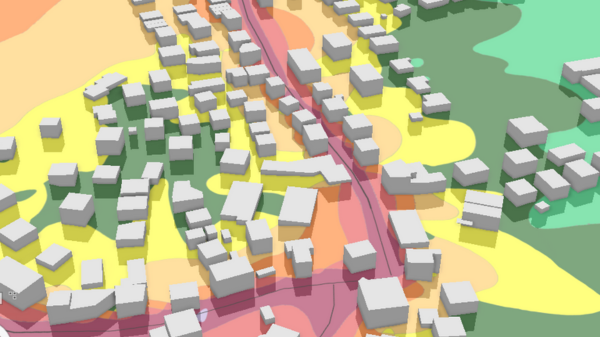
Using the harmonised data, we build an overall noise model that accurately represents the perimeter defined by the client. This process is partially automated, allowing us to minimise manual sources of error while creating the model quickly and efficiently. For large-scale projects, this is an indispensable tool.
Scenario calculations for monitoring
A further step in noise modelling involves calculating scenarios for continuous monitoring. This makes it possible to simulate noise immissions under different boundary conditions. As a result, we can generate precise forecasts and, together with our clients, plan targeted noise reduction measures. We take into account not only current traffic data but also projections, enabling potential future noise issues to be identified at an early stage.
Small-scale extracts for detailed analyses
Generating small-scale extracts from the overall noise model ensures that engineers can analyse specific areas or situations in greater detail. These extracts allow for targeted assessments of the noise situation. Based on this precise data, tailored solutions can be developed to meet the specific requirements of each project. This level of detail is essential to address both current demands and future challenges.
Our expertise: acoustics and noise modelling for large projects
Thanks to our many years of experience in acoustics and noise modelling, we develop customised solutions for very large projects. We offer not only the technical expertise required for data homogenisation and modelling, but also the know-how needed to address specific challenges with precision. Our expertise supports the creation of noise models that are crucial for planning, monitoring and implementing mitigation measures. As a result, our clients receive not only accurate models, but also a clear and practical roadmap for implementing effective noise protection strategies.
Conclusion
Noise modelling is essential for the planning and implementation of infrastructure projects, as well as for monitoring purposes. A reliable data basis is critical, both in terms of completeness and consistency. With our data homogenisation solution and our expertise in acoustics, we successfully meet these challenges and provide tailored answers to our clients’ needs.
If you are looking for an efficient, reliable and future-proof solution for your noise modelling, please get in touch.
/www.gundp.ch/file/897/01-Gesamtla%CC%88rmmodell-mit-einheitlichem-Datenstand_neu.jpg)
/www.gundp.ch/file/1955/Titelbild_Blogpost_SLIP20_L%C3%A4rmberechnungssoftware_v1.png)
/www.gundp.ch/file/3057/3d-city-models-as-a-tool-for-noise-protection.png)